
Skill for a Virtual Assistant: Why Marketplace Store Management Pays the Most

Key Takeaways
Marketplace store management is the top-paying skill for a virtual assistant in ecommerce. See what the job involves and what it pays in the Philippines.
Not all VA skills pay the same.
Some skills get you hired. One skill gets you hired, trusted, and paid more within the first few months. That skill is marketplace store management, running the daily operations of a seller’s Shopee, Lazada, or TikTok Shop account. It is the single most requested skill in ecommerce VA job posts, and it is the fastest path from entry-level pay to something closer to what an experienced VA earns.
This guide breaks down exactly what marketplace store management involves, why sellers pay more for it, and how to build it from zero, even before you land your first client.
What Is Marketplace Store Management, and Why Does It Pay the Most?
Marketplace store management is the skill of running a seller’s day-to-day operations inside Shopee Seller Centre, Lazada Seller Center, or TikTok Shop Seller Center: listings, orders, stock levels, and customer chat. It pays more than general admin work because it directly affects whether the seller makes money that day.
Think of it as the difference between supporting a business and running part of it. A general admin VA answers emails and manages a calendar. A marketplace-skilled VA logs into the seller dashboard and keeps the store itself functioning: products stay listed correctly, orders ship on time, stock counts stay accurate, and customer messages get answered before they turn into cancellations or bad reviews.
Sellers notice the difference fast. Miss an order deadline and the marketplace penalizes the store’s rating. List a product with the wrong variant and refunds pile up. A VA who prevents these problems is worth protecting, and worth paying more to keep.
That is the whole logic behind why this skill sits at the top of the pay scale. It is not about doing more tasks. It is about doing the tasks that touch revenue directly.
What Does Product Listing and Catalog Management Actually Involve?
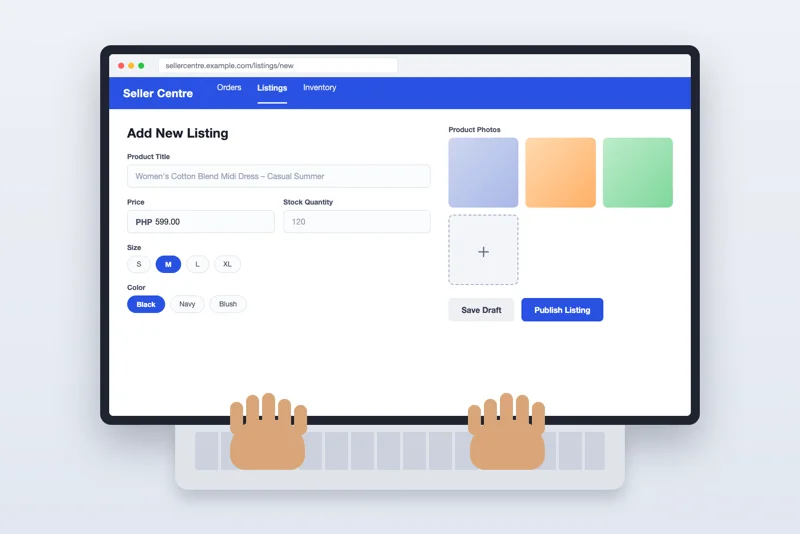
Product listing and catalog management means uploading, editing, and maintaining product pages: titles, descriptions, images, pricing, and variants (size, color) across one or more marketplaces. A VA who does this well keeps listings accurate, keyword-rich, and consistent whenever the seller adds or changes stock.
This is where most marketplace VAs start, because it is the most learnable piece of the skill.
A typical listing task looks like this: the seller sends new product photos and basic details. You write a clear, keyword-rich title, draft bullet-point features, set the price and any variants, and upload it to Shopee or Lazada using their listing tools. Then you check the live listing for formatting errors before moving to the next one.
The part that separates a good listings VA from an average one is consistency. Titles need to follow the same structure across the whole catalog. Prices need to match promotions and bundle deals exactly. A single typo in a price field can cost a seller real money if a customer orders before it is caught. Careful, repeatable process matters more here than creativity.
What Does Order Processing and Fulfillment Coordination Involve?
Order processing and fulfillment coordination covers confirming new orders, coordinating with the seller or a warehouse team to pack and ship them, updating tracking numbers, and flagging delays before they breach the marketplace’s shipping deadline. Missed deadlines directly hurt a store’s seller rating.
This is the highest-stakes part of marketplace store management, because marketplaces like Shopee and Lazada enforce strict shipping windows. Miss one too often and the platform can suspend promotional features or lower the store’s visibility in search.
A typical day includes checking the orders tab for anything new, confirming stock is available, generating the shipping label or handing off details to whoever packs the order, and updating the tracking number in the system. When something goes wrong, an item is out of stock or a courier pickup is delayed, the VA who catches it early and messages the customer proactively is the one sellers trust with more responsibility.
This section of the job rewards attention to detail over speed. A VA who processes fifty orders accurately beats one who processes eighty and makes shipping errors on five of them.

Curious how your current skills stack up? Take the free VA Career Readiness Scorecard (12 questions, about 3 minutes) and see exactly which marketplace skills to prioritize next.
What Does Inventory and Stock Tracking Involve?
Inventory and stock tracking means keeping accurate counts of what is in stock, updating quantities across marketplaces as items sell, and flagging low-stock items before they run out mid-promotion. VAs typically manage this in a spreadsheet that mirrors the numbers shown on each seller dashboard.
Nothing frustrates a customer, or a seller, faster than an order placed for an item that is actually out of stock. That mismatch usually happens because inventory was not updated across every platform the seller sells on.
A VA handling this well maintains a master spreadsheet with current stock counts, cross-checks it against each marketplace’s live listing at least once a day, and flags items approaching zero stock before a promotion goes live. Google Sheets, with basic conditional formatting to highlight low-stock rows in red, is the standard tool for this, no special software required.
This is also where a VA starts to earn a seller’s trust with numbers, not just tasks. A weekly stock report that flags what is running low and what is overstocked shows the seller you understand the business, not just the checklist.

How Much More Do Marketplace-Skilled VAs Get Paid?
Entry-level ecommerce VAs without marketplace skills typically earn PHP 15,000-25,000 per month. VAs who can independently run listings, order processing, and inventory across one marketplace typically earn PHP 30,000-45,000 or more, based on the pay ranges we see across OnlineJobs.ph and VirtualStaff.ph job posts.
| VA Level | Skill Level | Typical Monthly Pay (PHP) |
|---|---|---|
| Entry-level admin VA | General admin tasks only, no marketplace exposure | 15,000-25,000 |
| Marketplace VA (single platform) | Listings, orders, inventory on one marketplace | 30,000-45,000 |
| Marketplace VA (multi-platform) | Same skills across Shopee, Lazada, and TikTok Shop | 40,000-55,000 |
| Marketplace operations lead | Manages a small VA team plus reporting and ads oversight | 55,000-70,000+ |
These are typical ranges, not guarantees. Your actual pay depends on the seller’s budget, your response speed during the interview process, and how clearly you can demonstrate the skill before you are hired. But the pattern holds across the postings we track: sellers consistently pay more for VAs who can run the store, not just support it.
How Do You Learn Marketplace Store Management Without a Client Yet?
You can learn marketplace store management for free using a practice Shopee or Lazada seller account, a mock product catalog, and a sample order-tracking spreadsheet. Most beginners reach basic competence in two to four weeks of focused daily practice, and confident, solo-store readiness in two to three months.
You do not need a real store, and you do not need to wait for a client to start building this skill. Every marketplace lets you create a free seller account for exploration.
Here is a practice plan that costs nothing:
- Create free seller accounts. Sign up for Shopee Seller Centre and Lazada Seller Center. Click through every tab: listings, orders, chat, and the ads panel.
- Build a mock catalog. Upload twenty sample product listings with titles, descriptions, pricing, and variants. Aim for consistent formatting across all twenty.
- Build an inventory tracker. Create a Google Sheet mirroring the stock counts from your mock listings. Add conditional formatting to flag anything under five units.
- Simulate order processing. Walk through the order flow in each dashboard, from a new order notification to marking it shipped, so the steps feel automatic before a real customer is waiting.
- Practice chat responses. Write templated replies for common situations: delayed shipment, stock questions, and refund requests.
Shopee’s own Seller Education Hub has free video modules that walk through each part of the dashboard in detail, and it is worth going through before your first application. Collect everything into one shared Google Drive folder. That folder becomes your portfolio link on OnlineJobs.ph and VirtualStaff.ph applications, and it shows a seller you already know your way around before day one.
If you are still building the fundamentals, our full guide to becoming an ecommerce virtual assistant walks through the entire path from zero to your first client.

Frequently Asked Questions
What is the highest-paying skill for a virtual assistant in ecommerce?
Marketplace store management, running the day-to-day operations of a Shopee, Lazada, or TikTok Shop account, is typically the highest-paying skill for an ecommerce virtual assistant. It covers listings, order processing, inventory, and customer chat, and it pays more because it touches revenue directly, not just admin support.
How long does it take to learn marketplace store management?
Most new VAs can learn the basics of marketplace store management in two to four weeks of focused daily practice using a free seller account. Reaching the point where you can confidently run a live store solo, handling order spikes and stock issues without guidance, typically takes two to three months of hands-on experience.
Do I need real store experience to apply for marketplace VA jobs?
No. You can build a practice portfolio using a free Shopee or Lazada seller account, mock product listings, and a sample order-tracking spreadsheet. Sellers hiring on OnlineJobs.ph and VirtualStaff.ph care more about demonstrated familiarity with the dashboard than a paid job history.
How much more do marketplace-skilled VAs get paid?
Based on the pay spread we see between general admin VA listings and marketplace-specialist listings on OnlineJobs.ph, VAs with marketplace store management skills typically earn 30-50% more than VAs offering only generic administrative support. The gap widens further for VAs who manage multiple stores or platforms.
Which platform should I learn first: Shopee, Lazada, or TikTok Shop?
Start with Shopee Seller Centre if you are targeting Philippine or Southeast Asian sellers, since Shopee has the largest seller base in the region. Add Lazada Seller Center next. TikTok Shop is newer and has fewer VAs who know it well, which can work in your favor once you have the basics down.
Keep Reading
- Skills for a Virtual Assistant: The Complete Guide
- Tools for a Virtual Assistant: Ecommerce VA Toolkit
- No Experience Virtual Assistant Jobs
Ready to See Where You Stand?
Knowing the skill is step one. Knowing whether you are ready to apply is what actually gets you hired.
Take the free VA Career Readiness Scorecard
12 questions. About 3 minutes. No cost, no signup wall to see your score.
Frequently Asked Questions
What is the highest-paying skill for a virtual assistant in ecommerce?
How long does it take to learn marketplace store management?
Do I need real store experience to apply for marketplace VA jobs?
How much more do marketplace-skilled VAs get paid?
Which platform should I learn first: Shopee, Lazada, or TikTok Shop?
Related Articles
Working as a Virtual Assistant From Home: A Real Week
What working as a virtual assistant from home really looks like in the Philippines: a typical day, home setup, honest pros and cons, pay, and taxes.
Virtual Assistant Work: What Sellers Are Hiring For
Find real virtual assistant work in the Philippines: which tasks pay best, where to apply, and how beginners land their first ecommerce VA client.
VA Agencies in the Philippines: Which One Fits You?
A roundup of ecommerce VA agencies hiring in the Philippines, what each specializes in, real pay ranges, and how to vet one before you apply.
Ready to start your ecommerce career?
Explore career paths, build in-demand skills, and connect with employers across Southeast Asia.
Explore Career Paths